

Taking more vitamins may be the wrong first step. If you’re asking how to fix poor vitamin absorption, first distinguish limited intake from difficulty absorbing nutrients or another health issue. Increasing a dose without understanding the cause may be ineffective and, for some nutrients, unsafe.
Fatigue, digestive changes, and other symptoms can offer clues, but they have many possible causes and can’t confirm a deficiency. If a concern persists, you have relevant medical history, or symptoms affect daily life, seek clinical assessment rather than guessing with supplements.
This guide explains common reasons absorption may be impaired, how they differ from simply not getting enough vitamins, and which signs and health factors warrant medical evaluation. It also covers practical food and supplement considerations, including what delivery technologies such as nano-encapsulation can and cannot tell you. The goal is to help you choose informed next steps without treating a supplement as a diagnosis or cure.
Key Takeaways
- Low vitamin intake and impaired absorption are different problems. A suspected deficiency alone does not establish malabsorption.
- Absorption depends on the nutrient and on how digestion and intestinal function support its uptake.
- Increasing a supplement dose may not address the underlying issue, and symptoms alone can’t identify the cause.
- To explore how to fix poor vitamin absorption, record your diet, medicines, supplements, timing, symptoms, and relevant health history before seeking assessment.
- Nano-encapsulation is a supplement delivery approach, not a diagnosis or treatment for an underlying absorption condition.
Table of Contents
- What Does Poor Vitamin Absorption Mean, and How Is It Different from Low Intake?
- How Vitamin Absorption Works, and Where the Process Can Be Disrupted
- Poor Vitamin Absorption: Common Assumptions, Clues, and What They Can, and Cannot, Tell You
- What to Do If You Suspect Poor Vitamin Absorption
- Where Nano-Delivery Fits: Understanding Supplement Formulation Without Overpromising
What Does Poor Vitamin Absorption Mean, and How Is It Different from Low Intake?
A low vitamin level can result from too little of that nutrient in the diet, difficulty absorbing it, or a combination of factors. The distinction matters: changing food choices may help address low intake, while impaired absorption may call for assessment of digestive function, health conditions, or medicines. A suspected deficiency alone doesn’t prove malabsorption or identify its cause.
Inadequate intake means not consuming enough of a nutrient over time; impaired absorption means the body takes up less of a nutrient than expected despite its presence in the diet. This distinction is a starting point for considering how to fix poor vitamin absorption, not a way to diagnose it from symptoms alone.
Low vitamin intake or impaired absorption: what is the difference?
Intake is about what you eat. For example, someone whose usual diet contains few sources of a particular vitamin may not consume enough over time. Absorption concerns what happens after food or a supplement is consumed: digestion and intestinal processes may not transfer the nutrient into the body as expected. Limited intake and reduced uptake can also occur together.
Symptoms such as tiredness, weakness, or digestive changes don’t reliably distinguish between these possibilities. They can have many causes, and different nutrient deficiencies can produce overlapping effects. A test may identify a low level, but it doesn’t necessarily explain why that level is low. Diet, medicines, health history, and clinical assessment help put the result in context.
Why fat-soluble and water-soluble vitamins behave differently
Vitamins are commonly grouped by how they dissolve. Vitamins A, D, E, and K are fat-soluble, while vitamin C and the B vitamins are water-soluble. This classification describes a broad chemical property, not a single absorption pathway shared by every vitamin. The Vitamin absorption overview introduces these categories, but individual nutrients still differ in how the body processes them.
Fat-soluble vitamins are absorbed alongside dietary fats, so processes involved in digesting and handling fat can matter. Simply adding more fat to a meal won’t necessarily correct an absorption problem; the underlying digestive process and the specific nutrient are relevant. Water-soluble vitamins generally enter body fluids more readily, but their uptake also varies. Vitamin B12, for instance, requires a specialised process involving intrinsic factor and absorption in the small intestine. The body stores B12 in the liver, so low intake may take time to affect those stores.
These differences are one reason a single supplement rule doesn’t apply to every vitamin. The nutrient involved, intake pattern, and digestive conditions all shape the picture. If a deficiency is suspected or confirmed, identifying whether intake or absorption is contributing requires more than matching a symptom to a vitamin or increasing a dose independently.
How Vitamin Absorption Works, and Where the Process Can Be Disrupted
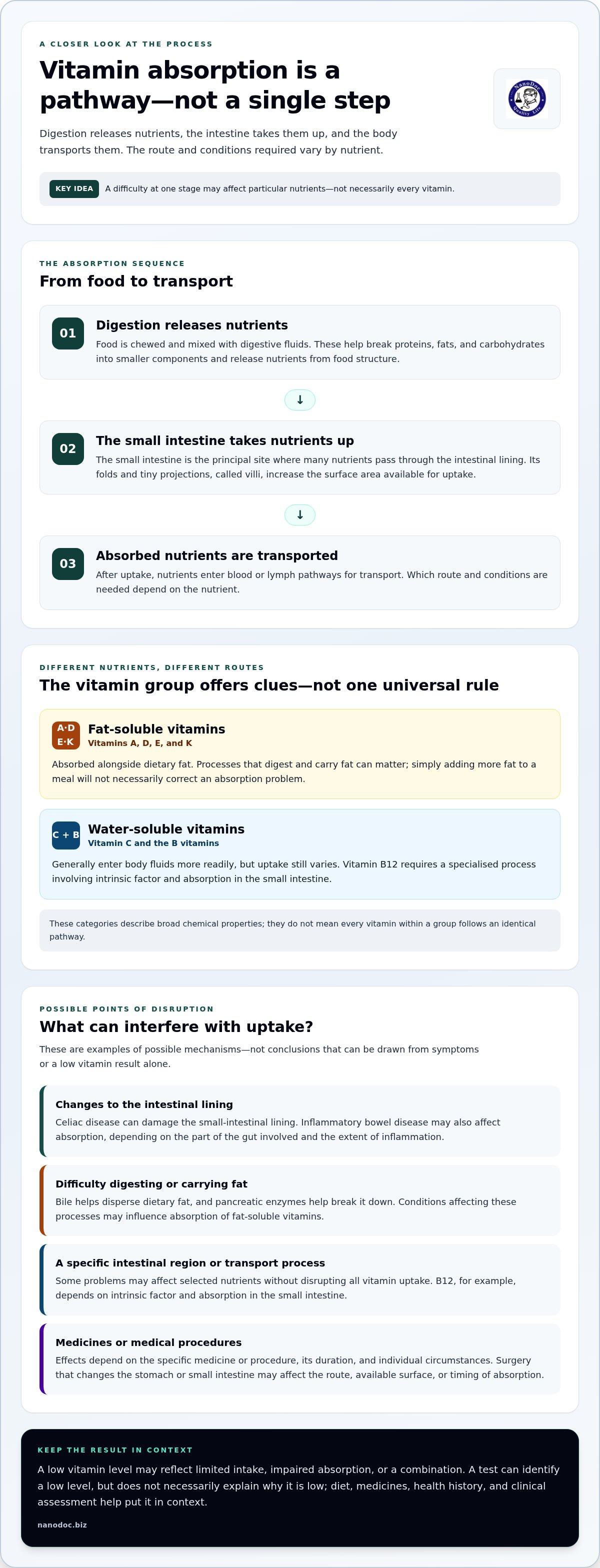
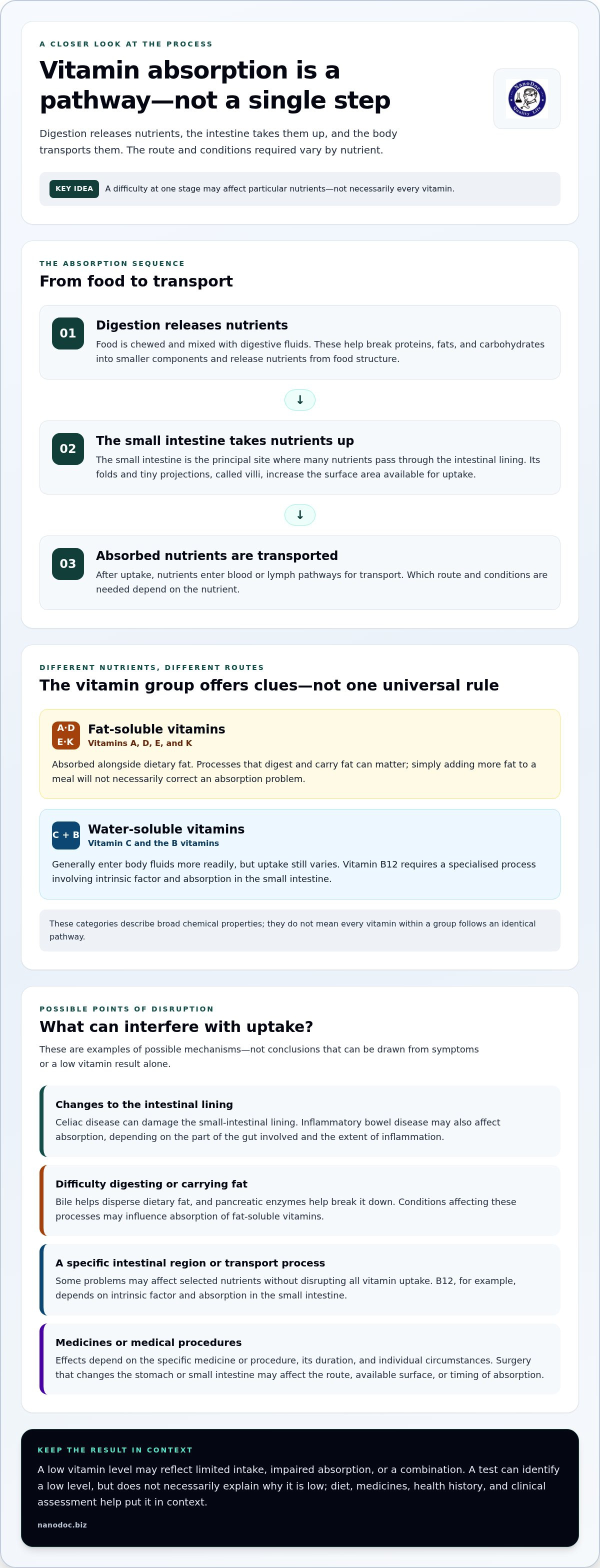
Absorption is a sequence, not a single event. Digestion breaks food down and releases nutrients from its structure; the body then takes them up and transports them where they’re needed. A difficulty at one stage may affect particular nutrients rather than every vitamin. Understanding the pathway helps explain why there isn’t one universal answer to how to fix poor vitamin absorption.
From digestion to uptake in the small intestine
Food is chewed and mixed with digestive fluids, which help break proteins, fats, and carbohydrates into smaller components. The stomach contributes to this process, but the small intestine is the principal site where many nutrients pass through the intestinal lining. Its inner surface is folded and covered with tiny projections called villi, which increase the area available for uptake. Once absorbed, nutrients enter blood or lymph pathways for transport.
The small intestine absorbs many digested nutrients through its extensive lining, while the route and conditions required for uptake vary by nutrient. Water-soluble vitamins generally enter the bloodstream through intestinal transport, while fat-soluble vitamins are absorbed alongside dietary fat and rely on processes that help digest and carry fat. Neither description means every vitamin in a group behaves identically.
Health factors that may interfere with absorption
Changes to the intestinal lining can make uptake less efficient. In celiac disease, an immune response to gluten can damage the small-intestinal lining. Inflammatory bowel disease may also affect absorption, depending on which part of the gut is involved and the extent of inflammation. These are examples of possible mechanisms, not conclusions that can be drawn from symptoms or a low vitamin result alone.
Fat digestion is another point of difference. Bile helps disperse dietary fat, and pancreatic enzymes help break it down. Conditions affecting these processes may influence absorption of fat-soluble vitamins. By contrast, a problem involving a specific intestinal region or transport mechanism may affect selected nutrients without disrupting all vitamin uptake.
Medicines and medical procedures can also be relevant. Their effects depend on the specific medicine or procedure, its duration, and individual circumstances. Some medicines alter digestive conditions or nutrient handling; surgery that changes the stomach or small intestine may affect the route, available surface, or timing of absorption. A medication list and health history can therefore be useful in clinical assessment. Don’t stop a prescribed medicine or start high-dose supplements based only on a suspected interaction.
The same low nutrient result can have different explanations: limited dietary sources, altered digestion, intestinal changes, or several factors together. Identifying which possibility fits requires more than a general food adjustment. For readers considering supplement delivery as a separate formulation question, Nano Cellular Essential Nutrition offers context on NanoDoc’s nutrition products. A delivery approach does not diagnose or resolve an underlying digestive condition.
Poor Vitamin Absorption: Common Assumptions, Clues, and What They Can, and Cannot, Tell You
A common assumption is that if a vitamin isn’t helping, taking more will solve the problem. But a higher dose doesn’t show whether the nutrient is being absorbed poorly, whether intake is inadequate, or whether symptoms have another cause. It can also increase the chance of excessive intake or interactions. A more useful question is what evidence supports a deficiency and what might explain it.
Symptoms can raise questions, but they cannot confirm a vitamin deficiency. Fatigue, weakness, appetite changes, and digestive discomfort can have many possible explanations. Persistent symptoms or changes that affect daily life are worth discussing, but they aren’t reliable tools for identifying a specific vitamin or diagnosing malabsorption.
Can symptoms tell you which vitamin is not being absorbed?
Usually, symptoms alone can’t identify the nutrient involved. Different deficiencies may share features, and similar changes can arise from conditions unrelated to vitamin status. A symptom list or online match can suggest questions to raise, but it can’t establish a diagnosis. A clinician may interpret symptoms alongside dietary patterns, health history, examination, and appropriate tests.
Focus on the pattern and duration rather than trying to name a vitamin: when did the change begin, is it worsening, and are digestive symptoms occurring alongside it? Persistent, severe, or concerning symptoms merit clinical review. Ongoing diarrhoea, unexplained weight loss, or symptoms that interfere with normal activities deserve attention rather than repeated self-treatment with supplements.
Why taking more supplements is not a reliable fix
Increasing a dose doesn’t correct every possible cause. If the issue is limited dietary intake, the overall eating pattern may need attention. If an underlying digestive condition is affecting uptake, a larger dose may not address that condition. And if symptoms come from another health issue, extra vitamins may delay the right assessment. That’s why how to fix poor vitamin absorption starts with understanding the concern, not automatically escalating a dose.
Supplement safety depends on the nutrient, amount, duration, other products being taken, and personal health circumstances. Some nutrients have established upper intake limits, and supplements may interact with medicines or duplicate ingredients in a multivitamin and separate products. “More” isn’t a neutral adjustment, even if a product is sold without a prescription.
For a practical review, bring the names and labels of supplements you use, including doses and how often you take them. Note any changes you’ve made and when symptoms occur. A qualified clinician can advise whether testing is appropriate and how results fit your situation; a pharmacist can help review potential medicine and supplement interactions. Until then, avoid starting high-dose products or combining several supplements to test a theory. Everyday dietary improvements may support adequate intake, but they shouldn’t replace assessment of persistent symptoms or suspected impaired absorption.
What to Do If You Suspect Poor Vitamin Absorption
A measured next step is more useful than changing several foods or supplements at once. If you’re concerned about how to fix poor vitamin absorption, follow a clear sequence: record what you’ve noticed, review possible contributors, seek clinical assessment when warranted, and follow advice based on your situation. This helps separate observations from assumptions and gives a clinician useful context.
How to prepare for a clinical assessment
Before an appointment, write down when symptoms began, how often they occur, and whether they relate to meals or supplements. Include known digestive diagnoses, relevant procedures, dietary restrictions, and recent changes in eating patterns. Bring a current list of medicines and supplements, with product names, doses, and timing. These details help put a suspected vitamin in context.
Assessment is individual. Based on your symptoms and history, a clinician may decide whether an examination or laboratory testing is appropriate and which tests would answer the relevant question. There is no single fixed test panel that establishes every cause of poor absorption. Don’t start consumer testing or change supplement doses as a substitute for interpreting results with a qualified professional.
Everyday steps while the cause is being assessed
Continue a varied diet that suits your health needs, unless a clinician has advised otherwise. Record meaningful dietary changes, but avoid restrictive eating based on an unconfirmed suspicion. Don’t stop prescribed medicines or begin high-dose supplements without professional advice. A clinician or pharmacist can review whether a medicine, supplement, or combination may be relevant to your circumstances.
Use this ordered pathway to prepare and decide what to do next:
- Document your concerns. Record symptoms, timing, duration, and any changes you’ve noticed, without trying to diagnose the cause.
- Review your intake and medicines. List usual dietary patterns, restrictions, medicines, supplements, doses, and when you take them.
- Seek assessment. Discuss persistent or concerning symptoms and relevant health history with a qualified clinician, who can determine whether testing is appropriate.
- Follow the resulting guidance. Base changes to diet, medicines, or supplements on that assessment, and clarify how to interpret findings before acting on them.
If you’re also comparing supplement formats, distinguish formulation information from medical advice. A delivery system may describe how a nutrient is presented, but it doesn’t diagnose or correct an underlying digestive condition. The high-bioavailability nutrients guide explains delivery approaches without replacing clinical assessment.
For more context on supplement formulation, Nano Cellular Essential Nutrition presents NanoDoc’s nutrition products. Formulation details can inform product understanding, but they don’t establish that a nutrient deficiency exists or explain its cause.
Where Nano-Delivery Fits: Understanding Supplement Formulation Without Overpromising
Nano-encapsulation is a formulation approach that places or carries a nutrient within very small structures, with the aim of influencing how it is protected or delivered. It describes how a supplement is designed, not what is causing a person’s symptoms. A delivery system cannot diagnose or treat malabsorption, and it won’t necessarily resolve a condition affecting digestion or intestinal uptake.
What nano-encapsulation can explain, and what it cannot
Formulation and digestive function are related but distinct. A formulation may affect how an ingredient is presented during digestion; the body still has to process and absorb it through functioning biological pathways. Particle size alone doesn’t prove that a nutrient will be absorbed better or produce a particular health outcome. Evidence needs to relate to the specific nutrient, formulation, dose, and intended use.
Research findings for one delivery system or ingredient shouldn’t automatically be applied to another. Results depend on the formulation studied and the quality and relevance of available evidence. For anyone considering how to fix poor vitamin absorption, nano-delivery is a product-design consideration, not a substitute for identifying an underlying cause or following clinical guidance.
How to assess supplement information responsibly
Look for clear information about the nutrient and formulation, along with relevant quality-testing details. NanoDoc’s formulations are independently laboratory-tested to verify nanoparticle size and quality. This is a product-quality point; by itself, it doesn’t demonstrate clinical benefit or show that a formulation corrects malabsorption.
Keep the route of delivery clear, too. A product intended for use in the mouth and a supplement swallowed for digestive processing don’t necessarily follow the same route. Information about the mouth’s role in immunity, such as this overview of the oral hygiene and oral-immune gateway, concerns a different context from proving vitamin uptake through the gut. Don’t treat discussion of one route as evidence for another.
When reviewing claims, separate what a test verifies from what a clinical study demonstrates. Consider what was measured, which specific formulation was studied, and whether the evidence addresses a relevant outcome. These distinctions support informed decisions without turning a technology description into a promise.
For a closer look at the formulation approach, explore NanoDoc’s nano-nutrient formulations.
Make Your Next Step Evidence-Led
Understanding how to fix poor vitamin absorption begins with a more useful question: what could explain the concern, and what evidence would clarify it? Let that guide your conversation with a qualified clinician rather than allowing symptoms or supplement marketing to set the direction. A clear record of your concerns can make that discussion more focused.
Supplement formulation is a separate consideration. NanoDoc represents LG Bionano in South East Asia and brings nano-encapsulation into its nutrition offerings as a delivery approach, not a substitute for identifying or managing a health condition. Explore the formulation perspective while relying on clinical assessment to guide decisions about suspected deficiency or malabsorption.
To learn more about this approach, explore NanoDoc’s nano-nutrient formulations. Informed questions and measured next steps can help you make decisions with greater confidence.
Frequently Asked Questions
Can poor vitamin absorption cause symptoms even if I eat a balanced diet?
Yes. A balanced diet doesn’t rule out an absorption problem or guarantee that every nutrient is available to your body in the same way. What you eat, how consistently you eat it, dietary restrictions, digestive health, and medicines can all be relevant. Keep a short record of meals and symptoms, including when changes occur, then discuss persistent or concerning symptoms with a qualified clinician rather than self-identifying a deficiency.
How do you know if your body is not absorbing vitamins?
You can’t reliably confirm poor vitamin absorption from symptoms or from whether a supplement seems to help. If you’re wondering how to fix poor vitamin absorption, begin with an assessment rather than a home diagnosis. A clinician can consider your health history, dietary pattern, medicines, and symptoms, then decide whether examination or targeted laboratory tests are appropriate. Share recent supplement changes, since they may affect how results are interpreted.
What happens if vitamin malabsorption is left untreated?
The impact depends on the nutrient involved, the extent and duration of reduced uptake, and its underlying cause. A persistent deficiency may affect normal body functions, but possible effects differ and can’t be predicted from symptoms alone. If a test has shown a low nutrient level, ask what follow-up is appropriate and whether the result needs investigation. Seek prompt medical advice for severe or worsening symptoms rather than waiting to see if supplements help.
Can taking more vitamins fix poor absorption?
Not necessarily. A higher dose may not address the reason for reduced uptake, and adding a standalone supplement can duplicate nutrients already present in a multivitamin or fortified foods. Before changing your intake, compare the labels and note the total amount from products you use. A clinician or pharmacist can review potential interactions, health considerations, and whether a dose change is suitable for your circumstances.
Which vitamins are most affected by malabsorption?
There isn’t one vitamin group that is affected in every case. Problems with fat digestion may be relevant to vitamins A, D, E, and K, while conditions affecting other digestive processes can influence different nutrients. Vitamin B12 has specific absorption requirements, so its assessment may differ from that of other vitamins. The pattern depends on the underlying issue; a clinician can help identify which nutrients, if any, need evaluation.
Can nano-encapsulated supplements treat vitamin malabsorption?
No. Nano-encapsulation describes how a nutrient is formulated for delivery; it isn’t a diagnosis or treatment for an underlying malabsorption condition. Evidence about a delivery approach applies to the specific formulation studied and shouldn’t automatically be generalised to other products or health outcomes. If you have a diagnosed digestive condition or suspect a deficiency, discuss supplement choices with a qualified clinician before relying on a formulation or changing your current regimen.
Frequently Asked Questions
- Low vitamin intake or impaired absorption: what is the difference?
- Intake is about what you eat. For example, someone whose usual diet contains few sources of a particular vitamin may not consume enough over time. Absorption concerns what happens after food or a supplement is consumed: digestion and intestinal processes may not transfer the nutrient into the body as expected. Limited intake and reduced uptake can also occur together. Symptoms such as tiredness, weakness, or digestive changes don’t reliably distinguish between these possibilities. They can have many causes, and different nutrient deficiencies can produce overlapping effects. A test may identify a low level, but it doesn’t necessarily explain why that level is low. Diet, medicines, health history, and clinical assessment help put the result in context.
- Can symptoms tell you which vitamin is not being absorbed?
- Usually, symptoms alone can’t identify the nutrient involved. Different deficiencies may share features, and similar changes can arise from conditions unrelated to vitamin status. A symptom list or online match can suggest questions to raise, but it can’t establish a diagnosis. A clinician may interpret symptoms alongside dietary patterns, health history, examination, and appropriate tests. Focus on the pattern and duration rather than trying to name a vitamin: when did the change begin, is it worsening, and are digestive symptoms occurring alongside it? Persistent, severe, or concerning symptoms merit clinical review. Ongoing diarrhoea, unexplained weight loss, or symptoms that interfere with normal activities deserve attention rather than repeated self-treatment with supplements.
- Can poor vitamin absorption cause symptoms even if I eat a balanced diet?
- Yes. A balanced diet doesn’t rule out an absorption problem or guarantee that every nutrient is available to your body in the same way. What you eat, how consistently you eat it, dietary restrictions, digestive health, and medicines can all be relevant. Keep a short record of meals and symptoms, including when changes occur, then discuss persistent or concerning symptoms with a qualified clinician rather than self-identifying a deficiency.
- How do you know if your body is not absorbing vitamins?
- You can’t reliably confirm poor vitamin absorption from symptoms or from whether a supplement seems to help. If you’re wondering how to fix poor vitamin absorption, begin with an assessment rather than a home diagnosis. A clinician can consider your health history, dietary pattern, medicines, and symptoms, then decide whether examination or targeted laboratory tests are appropriate. Share recent supplement changes, since they may affect how results are interpreted.
- What happens if vitamin malabsorption is left untreated?
- The impact depends on the nutrient involved, the extent and duration of reduced uptake, and its underlying cause. A persistent deficiency may affect normal body functions, but possible effects differ and can’t be predicted from symptoms alone. If a test has shown a low nutrient level, ask what follow-up is appropriate and whether the result needs investigation. Seek prompt medical advice for severe or worsening symptoms rather than waiting to see if supplements help.
- Can taking more vitamins fix poor absorption?
- Not necessarily. A higher dose may not address the reason for reduced uptake, and adding a standalone supplement can duplicate nutrients already present in a multivitamin or fortified foods. Before changing your intake, compare the labels and note the total amount from products you use. A clinician or pharmacist can review potential interactions, health considerations, and whether a dose change is suitable for your circumstances.
- Which vitamins are most affected by malabsorption?
- There isn’t one vitamin group that is affected in every case. Problems with fat digestion may be relevant to vitamins A, D, E, and K, while conditions affecting other digestive processes can influence different nutrients. Vitamin B12 has specific absorption requirements, so its assessment may differ from that of other vitamins. The pattern depends on the underlying issue; a clinician can help identify which nutrients, if any, need evaluation.
- Can nano-encapsulated supplements treat vitamin malabsorption?
- No. Nano-encapsulation describes how a nutrient is formulated for delivery; it isn’t a diagnosis or treatment for an underlying malabsorption condition. Evidence about a delivery approach applies to the specific formulation studied and shouldn’t automatically be generalised to other products or health outcomes. If you have a diagnosed digestive condition or suspect a deficiency, discuss supplement choices with a qualified clinician before relying on a formulation or changing your current regimen.